
Siena was the great rival of Florence in both politics and art. Its artists were more conservative than the Florentine Schools, but the city was just as ambitious. Through competent governance, Siena established itself as the main rival to the Medici Family. Today, the region retains its remarkable medieval urban architecture in Siena and the many towns that once defined the Republic.
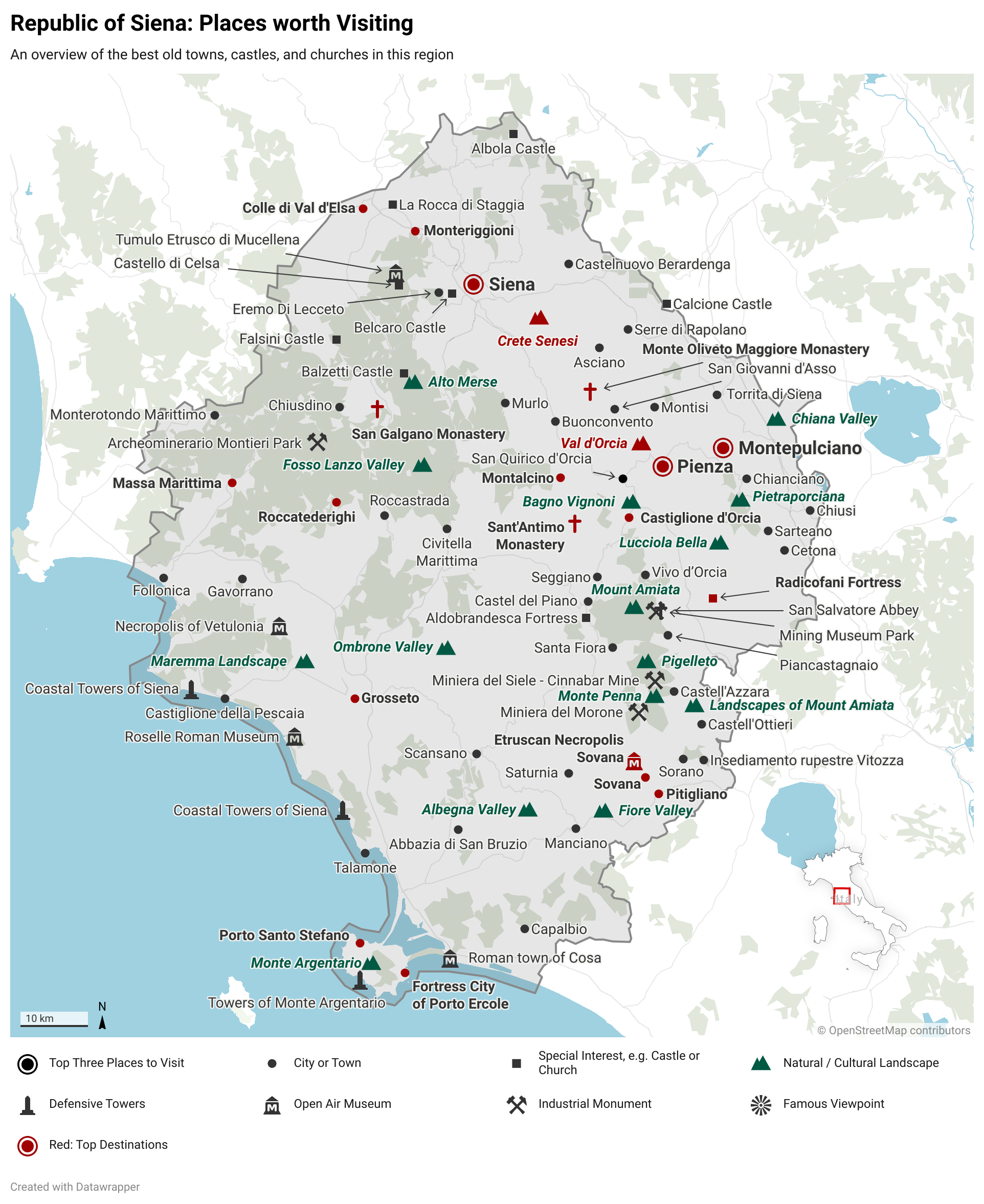
The lands of Siena are perhaps the most beautiful in Tuscany, full of rolling hills and terraced vineyards. The region is based around a series of highland villages founded during the Etruscan era, and their remoteness precluded meaningful development. Siena was the exception, as the city’s walls offered traders protection from coastal raiders. Today Siena is the center of Tuscany’s most famous landscapes and wines.
The Republic of Siena was the foil to the grand narrative of Florence. If Florence was the protagonist of Renaissance Tuscany, then Siena was its nemesis in everything, from politics to art. In this endeavor, Siena was, in many ways, at a fundamental disadvantage to Florence. Whereas trade through Florence could flow along the River Arno to the ocean, Siena depended on overland trade routes. Florence was also a Roman city of some significance, whereas Siena never even registered as a footnote in Roman annals.
In this respect, considering Siena as the rival to a state as resplendent as Florence does an excellent service to what the Sienese citizens were able to achieve. The Republic was born as a refuge from the conflicts that plagued Early Medieval Italy, as Byzantine and Lombard invasions pushed trade routes further inland. The ancient Etruscan redoubt of Siena emerged as a natural stronghold for pilgrims and traders.
It had an early start, with the high point of Sienese art occurring in the century before the Florentine Renaissance. The Cathedral of Siena is a masterpiece of the transitional period leading toward the Gothic style. Its artists mastered and perfected the late Gothic style of the Byzantines and continued to develop it long after it was considered outdated.
Politically, the Republic was known for its astute governance and trade policies. Though it never built a maritime empire like that of Pisa or Genoa, its banks were active throughout Italy. Eventually, though, the structural disadvantages that the Republic faced would be amplified by the destruction of the Black Death. The Republic prospered for a further two centuries but never achieved its lofty aspirations. Siena would finally fall to the armies of Florence in 1555.
This map shows the territorial extent of Siena before its fall in 1555. Though with some minor territorial additions, such as Montepulciano. The Republic had largely unified with these borders by the middle of the 15th century. Today, the larger region carries a strong sense of local identity, perhaps best-reflected in the annual Palio di Siena or a lively horse race around the center square.


