
Pisa is the only city in Tuscany with an unbroken urban tradition dating back to Roman times. Once much closer to the coast, Pisa built a maritime empire that stretched across the Tuscan Coast and the Mediterranean. Today it is a predominantly agricultural region, full of picturesque villages scattered in the fertile plains between the mountains and the rugged coast.
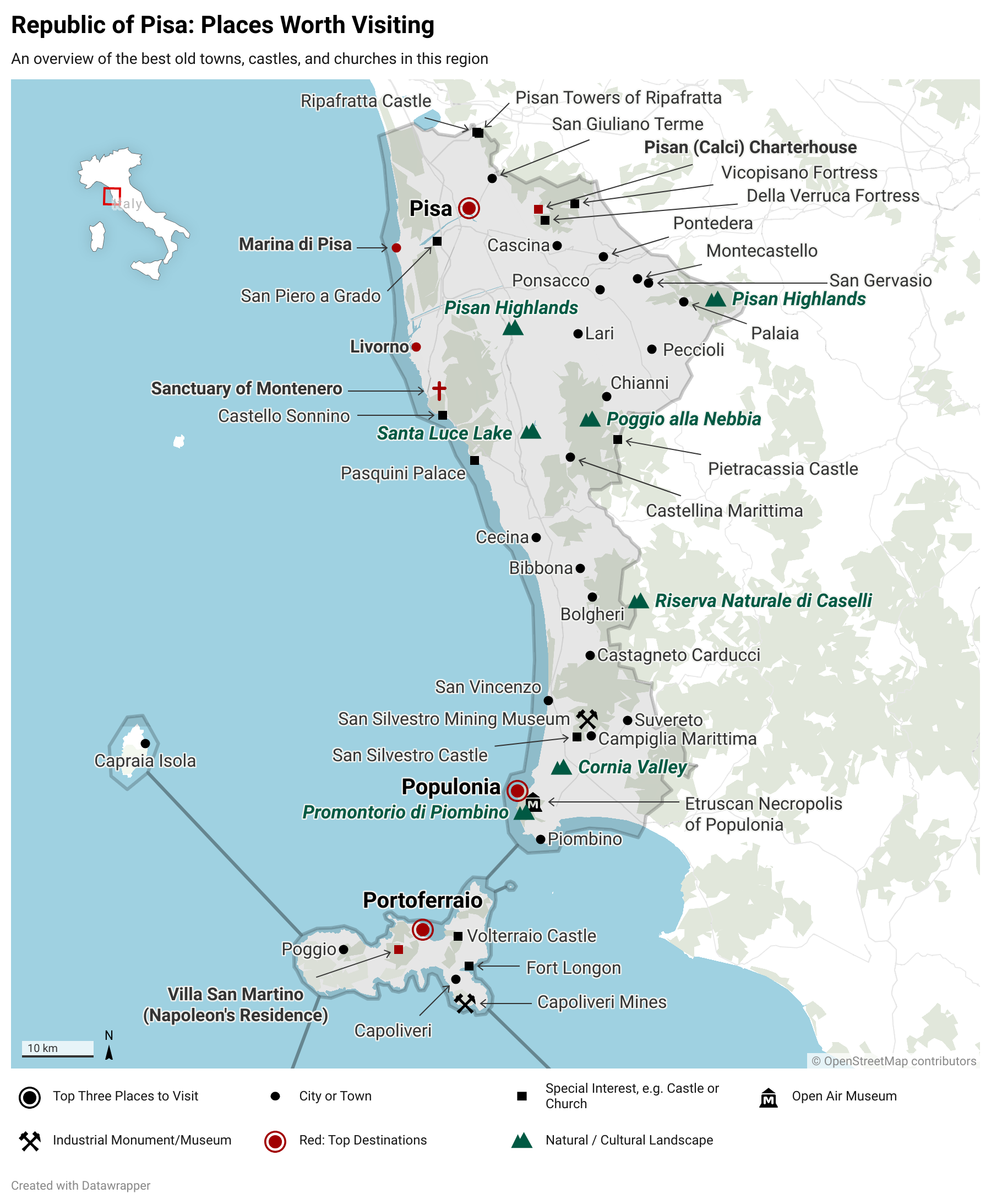
The lands of the old Pisan Republic are full of small towns and crumbling castles. With the Republic’s fall before the height of the Middle Ages, it never developed a legacy of stone beyond the walls of Pisa. The Second World War also took an enormous toll as it reduced Livorno and many of the Northern Town to ash and rubble. What Pisa continues to offer is a land of spectacular coastline and an interior of timeless charm.
The rise and fall of the Pisan Republic occurred in the centuries before the main act of the Tuscan Renaissance. By the time Pisa capitulated to Florentine rule in 1406, it was already living in the shadow of its former realm.
The Republic entered the global stage in 1016ce when a combined Pisan and Genoese armada expelled Islamic Raiders from Sardinia. They followed up by turning on Genoa and taking both Corsica and Sardinia for themselves. Pisan ships and mercenaries would assist the Norman conquest of Sicily and later the Crusades for Jerusalem. An alliance with the Byzantine Empire saw the Pisan flag raised across the Mediterranean.
The beginning of the end for Pisa was the continuous silt deposition by the River Arno, pushing the ocean further away from the city. Where Pisa was once a Roman port city, today it lies 11km from the sea. As its ports became less navigable, its empire began to crack. In 1284 a devastating defeat against Genoa started a chain of events that would see Pisa lose all of its maritime possessions by 1323.
The internal borders of the Pisan Republic constantly fluctuated throughout the Middle Ages. Mired in perpetual conflict from the very beginning with Lucca, Florentine expansionism only added to a difficult situation. The borders of the modern-day province of Pisa more or less track the ancient boundaries of Pisa at its height. The difficulty is in ascertaining when and for how long Pisa asserted control over any given part of its territory. The region I show here is a truncated version of the modern administrative region, accounting for a ring of fortified towns built to defend Pisa’s borders. It is, however, essentially a suggestion of the area over which Pisa has some authority in the high middle ages.


