Florence counts among the undisputed centers of the European Renaissance. Its cityscape inspires with its resplendent palaces and soaring churches designed by some of the most famous artists in history. While Florance has earned its reputation as a tourist colony, its incredible artistic heritage and unmatched level of preservation make it a worthy destination for everyone.
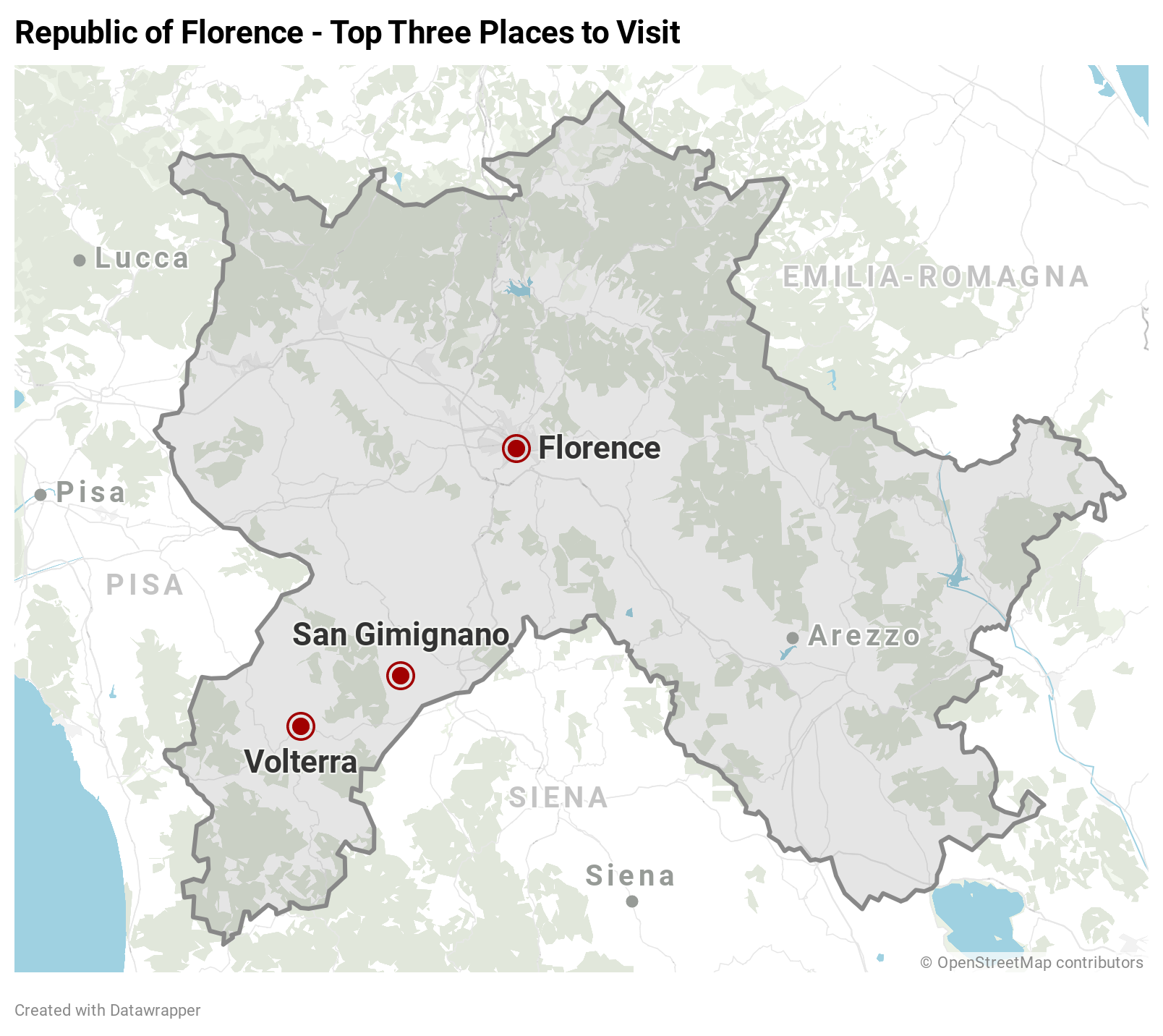
At its height, the Republic of Florence spanned a territory almost equivalent to the modern-day region of Tuscany. Only Lucca and the mountains of Massa and Carrara escaped Florentine domination. The use of the term ‘Republic’ is perhaps somewhat misleading in the case of Florence. Though hereditary rule ended the Republic only later in the 17th century, the Medici Family alone dominated the politics and direction of the state.
This family, more than anything, defined the politics, culture, and course of the Tuscan Renaissance. Their patronage is responsible for the great works of art that line our history books and the great monuments that tower above the city. To explore the lands of Florence is to explore the Medici legacy, and to understand it is to understand the origins of the European Renaissance.
The region shown here is Florence around 1450, with some liberties taken to simplify the political situation. It does not include territories outside of Tuscany, and I exclude exclaves or allied states such as Montepulciano, which geographically do not align. There are still some notable exceptions.