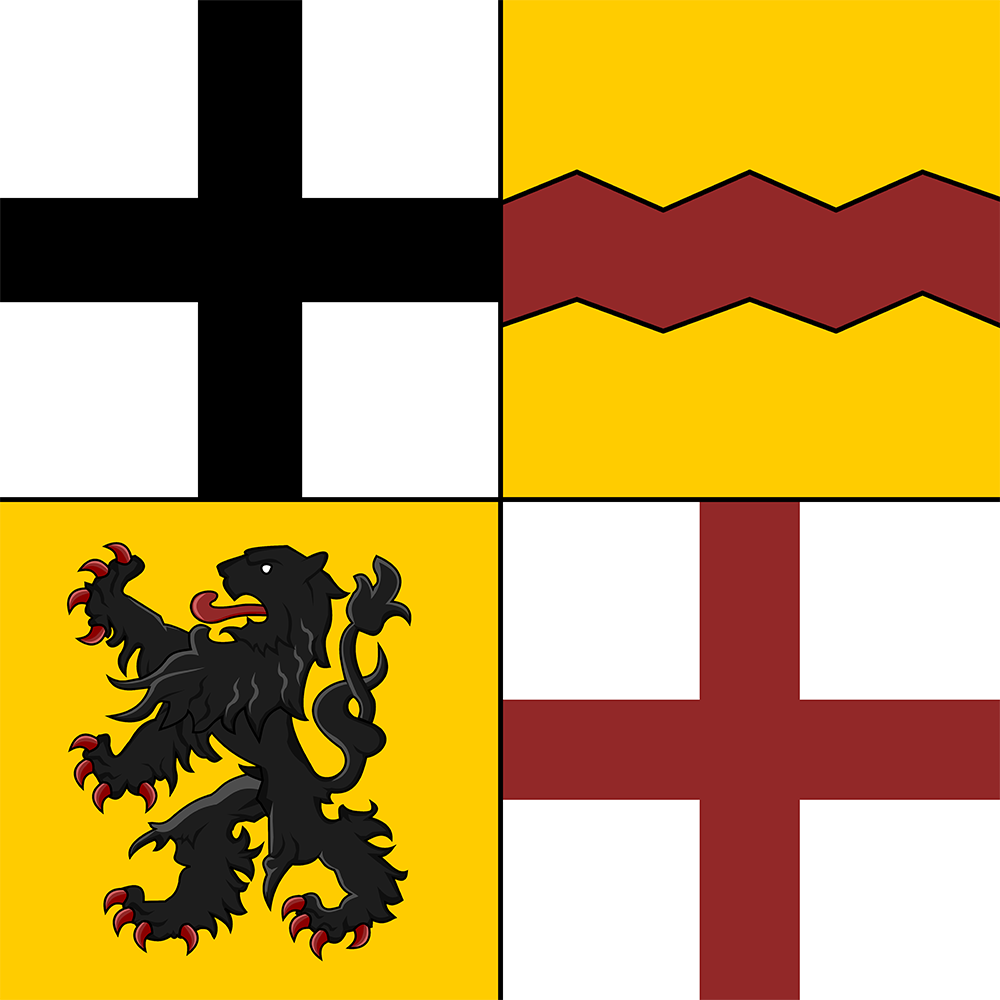
The Eifel is a land defined by traces of its ancient past, including landscapes of a violent volcanic past and hundreds of ruined border fortresses recalling centuries of political fragmentation. Caught between the Archbishops of Cologne and Trier, the competing powers of Jülich and Luxembourg, and scores of nameless princes and knights, the Eifel accumulated one of Germany's richest concentrations of medieval castles and abbeys.

The Eifel is a mid-elevation plateau and low mountain range covering over 5,300 km² of western Germany, spread across Rhineland-Palatinate and North Rhine-Westphalia. It forms the eastern portion of the broader Ardennes-Eifel highland, sharing its geology and deep prehistory with the Belgian and Luxembourgish Ardennes across the Our and Moselle rivers to the west. There is no sharp geological border — the name itself is simply where the German-speaking world begins and the French-speaking Ardennes end.
The Romans knew the entire region as the Arduenna silva and made it a vital economic zone: the Eifelwasserleitung, one of the longest aqueducts in the ancient world, carried spring water from the Eifel hills to Cologne, while the Trier–Cologne road crossed the plateau carrying troops, merchants, and imperial ambition. The first iron-smelting operation north of the Alps was established here in the 5th century BC, and the region remained an industrial heartland well into the medieval period.
In the Holy Roman Empire, the Eifel's location at the intersection of the Archbishoprics of Cologne and Trier, the Duchy of Jülich, the County of Luxembourg, and a dozen smaller lordships made it one of the most politically contested and fragmented regions in Germany. The resulting landscape of competing towers, abbey walls, and hilltop keeps is the Eifel's most visible historical legacy. Many of these survive as romantic ruins above river valleys — the Nürburg above the racetrack that bears its name, the Manderscheider Burgen twin castles above a volcanic maar, and the Kasselburg above Gerolstein among the finest.
The Eifel's volcanic heritage is equally distinctive. The Vulkaneifel in the south-center contains hundreds of extinct volcanoes, cinder cones, and the famous maars — circular crater lakes of haunting stillness. The Laacher See remains geologically active, its surface still releasing carbon dioxide today. The volcanic springs of the region gave rise to Germany's most famous mineral water brands, Gerolsteiner and Apollinaris, and the Gerolstein Vulkaneifel is recognized as a UNESCO Global Geopark.
The 19th and early 20th centuries were not kind to the Eifel. Prussian administrators nicknamed it Preußisch Sibirien — Prussian Siberia — and the region suffered devastating poverty and repeated wartime incursions. In 1944–45, the Battle of the Hürtgen Forest, one of the longest and most costly battles in American military history, tore through the northern Eifel. The scars are still visible in the cemeteries at Vossenack and the bunker ruins of the Westwall that still emerge from the forest floor.
Today the Eifel has reinvented itself. The Eifel National Park, established in 2004, protects the beech forests and moorlands of the north. The Eifelsteig long-distance trail connects Aachen to Trier across the full breadth of the plateau. And the Nürburgring, built in the 1920s to stimulate regional employment, has made this once-forgotten highland a destination for motorsport fans from across the world.


